
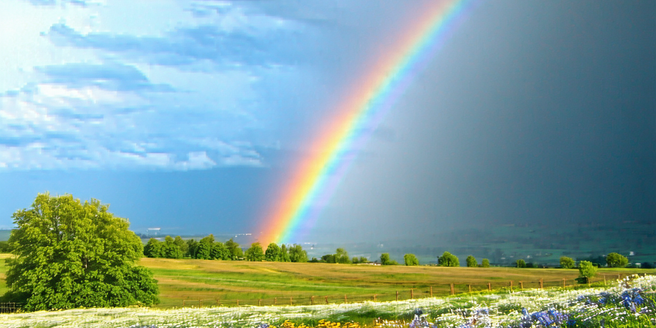
Understanding the Basics of Light and Color
Light is a form of energy that travels in waves, and its interaction with objects is what creates the colors we perceive. The visible spectrum, part of the electromagnetic spectrum, consists of different colors each with a unique wavelength. When white light, such as sunlight, enters a raindrop, it is refracted or bent because it moves from air to water—two materials of different densities. As the light continues through the droplet, it reflects off the back of the droplet and is refracted again as it exits back into the air. This bending and refracting of light causes its colors to spread out and separate into the spectrum that we can visually detect as a rainbow.
The Role of Water Droplets in Rainbow Formation
Water droplets play a crucial role in forming rainbows. Each droplet acts as a tiny prism, refracting and reflecting sunlight to display its component colors. The size and uniformity of the droplets can influence the appearance of the rainbow. Larger, more uniform droplets produce clearer, more vivid rainbows, while smaller droplets result in fainter, less distinct rainbows. As sunlight enters a droplet, it slows down and bends due to the change in medium, from less dense air to denser water, altering its path. Some of this light reflects off the back of the droplet and exits, bending again. This process of entry, reflection, and exit creates the arc of colors known as the rainbow. Countless droplets need to be present in the atmosphere for a perceptible rainbow to manifest.
Exploring the Angle of Refraction and Reflection
The formation of a rainbow is heavily influenced by the angle at which sunlight strikes a raindrop. This is known as the angle of refraction. When light transitions between different mediums, its speed changes, causing it to bend. This bending, or refraction, is maximized at a specific angle that varies with the wavelength of light, resulting in the separation of colors. Moreover, the angle of reflection within the droplet also plays a pivotal role. The classic angle for viewing a primary rainbow is approximately 42 degrees relative to the direction opposite the sun. This alignment allows each observer to see a slightly different set of droplets, making the rainbow appear as a full circle in ideal conditions from a high vantage point, though we often see an arc from the ground.
Why Rainbows Appear Curved in the Sky
The iconic curved shape of a rainbow is the result of the complex interaction between light and water droplets. Each droplet refracts and reflects light at specific angles, creating a circle of colors. However, on the ground, viewing limitations allow us to see only a semicircular arc. The curvature is determined by the observer’s angle of view and position relative to the light source, usually the sun, which must be behind the observer at a specific height in the sky. The arc is centered on the so-called anti-solar point, directly opposite the sun. This spherical geometry causes the rainbow to form a circle with a radius of about 42 degrees, offering a visual that appears curved when standing on the Earth’s surface.
Dispersion and the Spectrum of Colors
Dispersion is the process by which light separates into its different colors, forming a spectrum. This phenomenon occurs because different wavelengths of light refract, or bend, at slightly different angles when passing through a medium like water. In the case of rainbows, dispersion is visible when sunlight interacts with raindrops, breaking apart the composite white light into its constituent colors. Each color, from violet to red, is refracted at a different angle due to having unique wavelengths, with violet bending the most and red bending the least. These dispersed colors emerge as a spectrum arranged in a predictable pattern that we recognize as a rainbow. The band of hues is evidence of light’s intrinsic complexity and the laws of physics that dictate its behavior in various environments.
Phenomena Related to Rainbows: Double and Supernumerary Rainbows
Double rainbows occur when sunlight reflects twice inside water droplets, creating a second, fainter arc outside the primary rainbow. The secondary bow displays a reversed color order, with red on the inner edge. Supernumerary rainbows appear as additional, fainter bands of pastel colors inside the primary arc. They result from interference patterns of light waves, where certain wavelengths are reinforced or cancelled out. These phenomena underscore the intricate dance of light through varying paths and interactions within raindrops. Atmospheric conditions like droplet size and density variations can enhance or obscure these patterns, showing the spectrum’s complex beauty. Double and supernumerary rainbows illustrate the depth of natural optical events, revealing nature’s capacity for wonder when light and water mingle.