
Understanding Lunar Weather Phenomena
Lunar weather doesn’t follow traditional Earth patterns, but its effects are significant. Solar winds, cosmic rays, and a lack of atmosphere create unique challenges. The lunar surface’s exposure to cosmic phenomena can lead to fluctuations in surface temperature and radiation levels. As researchers develop innovative technology to counteract these challenges, new opportunities for lunar exploration are continually emerging. Analyzing these aspects is crucial for understanding how they can impact long-duration lunar missions. Any spacecraft navigating these conditions must be equipped to handle the radiation and extreme temperatures that result from these phenomena. Astronauts’ awareness and preparation for these conditions ensures mission success and safety on the Moon.
Challenges Faced by Apollo Missions
The Apollo missions faced unprecedented challenges on and around the Moon. One significant issue was communication across vast expanses and with the Earth. The lack of atmosphere further complicated landings and takeoffs. Managing supply chains for things like food, water, and fuel in a low-gravity environment required innovative solutions. Engineers and scientists were constantly working on ways to improve efficiency and safety. The inability to recycle resources necessitated careful planning. Furthermore, dust storms were also a challenge as they impaired visibility and could impact machinery. The mission control had to be highly adaptable, with contingency plans in place to manage unexpected problems seamlessly.
Impact of Moon Dust on Equipment
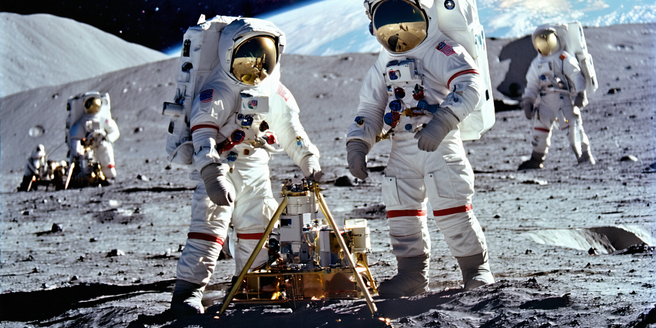
Lunar dust posed a severe challenge for the Apollo missions. Its fine, abrasive nature impacted instruments and suits, causing wear and degradation. The dust adhered to surfaces and crept into machinery and seals, risking mechanical failures. Scientists were particularly concerned about its potential to damage delicate equipment. The lack of atmosphere means that once disturbed, dust doesn’t easily settle. Engineers needed to account for this in spacecraft design, creating effective seals and solutions to minimize dust ingress. In addition, dust contamination could obscure sensors or critical components, which required constant maintenance during missions. Preventing its harmful effects was crucial for operational success.
Temperature Extremes and Mission Safety
The Moon’s temperature swings are extreme, varying from scorching heat to freezing cold. These fluctuations posed serious risks during the Apollo missions. Instruments, electronics, and human physiology had to withstand temperatures ranging from -173°C during the lunar night up to 127°C in sunlight. The lack of an atmosphere on the Moon means there is nothing to moderate these drastic temperature changes. Spacecraft thermal controls were vital to maintain a stable environment for operations. Insulation materials, heaters, and cooling systems were designed to protect equipment. Planning extravehicular activities (EVAs) necessitated careful consideration of thermal loads since exposure times varied with location, orbital parameters, and mission timelines, influencing astronauts’ comfort and health.
Lunar Storms and Astronaut Preparedness
Lunar storms, caused by solar activity, presented dangerous conditions for Apollo astronauts. These storms produce intense radiation, which is harmful without Earth’s protective magnetosphere. Astronauts had to be prepared for quick evacuation into well-shielded areas within the lunar module if forecasts indicated a solar storm. This proactive approach was critical for ensuring the safety of the crew during missions. Data collected from Apollo missions was instrumental in developing storm prediction models. Onboard instruments measured solar activity in real-time, providing early storm warnings. Protective measures were continually refined, contributing to safety protocols aimed at minimizing radiation exposure risks during lunar surface operations.
Adaptations and Innovations from Apollo Data
Data from Apollo missions led to innovations in spacecraft design and mission protocols. The challenges faced necessitated advancements in recycling and resource management for long-duration missions, inspiring new life-support systems. Improvements in fuel efficiency and storage occurred due to propulsion demands. A notable example is the development of more compact and efficient engines that have become a standard in subsequent space missions. Robotic system advancements from the missions have had long-lasting applications. Insights into lunar geology have guided exploration equipment design, ensuring durability and flexibility in lunar conditions. The legacy of Apollo’s innovation continues to influence modern space exploration and human endeavors, proving the enduring value of these landmark missions.