
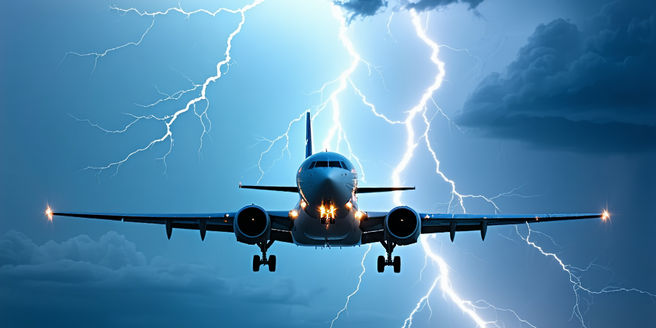
Understanding Lightning Strikes in Aviation
Lightning strikes are common in aviation, especially during thunderstorms. Pilots and airlines take precautions to avoid heavily stormy areas due to the electrical nature of lightning and the risks it poses. Lightning phenomena involve the discharge of electrical energy between clouds or between clouds and the ground. Aircraft, being metallic, offer a path of least resistance for this energy, potentially leading to minor damage. The risk exists primarily during takeoffs and landings. However, the structure of modern planes is designed to handle strikes efficiently. Understanding these dynamics is critical for maintaining safety in the skies.
The Science Behind Lightning and Aircraft
Lightning is a complex scientific phenomenon involving electric field variations within thunderstorm clouds. As an aircraft flies through these charged zones, it can inadvertently trigger a strike. The aluminum skin of the aircraft acts as a conductor, allowing lightning to pass through without causing significant harm. Pilots undergo extensive training to handle these situations and ensure passenger safety. Typical air traffic radar assists pilots in navigating through less stormy paths, reducing strike probability. Engineers also use lightning simulation labs to help design plane components that can withstand such electrical events. This scientific understanding continually informs safety protocols.
Historical Perspective: Lightning and Airplane Safety
Aviation history reveals the evolving understanding of lightning risks and the development of solutions to mitigate them. In the early days, lightning strikes were more concerning due to less robust aircraft designs. Over time, enhanced engineering and empirical knowledge have led to safer air travel. Advances in technology have also played a crucial role in ensuring aircraft safety. Aircraft have become better equipped to handle and dissipate lightning energy. Historical research and incident analysis have driven improvements in materials and techniques. Thus, past experiences have paved the way for the highly reliable protection systems present in today’s aircraft.
Modern Aircraft Design and Lightning Protection
With advancements in material science and engineering, modern aircraft are better fortified against lightning strikes than ever before. Design elements such as conductive paths in wingtips and specific grounding techniques channel lightning safely around the aircraft body. Notably, these advancements come as a direct response to increasing safety demands from both regulatory bodies and the flying public. Composite materials used in airframes are treated with conductive layers. Moreover, design consultations include extensive testing in simulated environments to assess strike resilience. The integration of such innovative designs has significantly improved the safety and durability of aircraft, contributing to heightened overall air transport safety.
Case Studies: Lightning Incidents in Aviation
Examining actual incidents provides valuable insights into aviation safety. Historical case studies where aircraft have encountered lightning showcase the effectiveness and occasional shortfalls of safety measures. While most incidents result in minor damage due to smart engineering, they still serve as critical learning tools for industry stakeholders. Such analysis not only highlights engineering prowess but also illuminates areas where additional focus is needed. Investigations into these events often lead to design and procedural improvements. These case studies illustrate the importance of ongoing vigilance and adaptation in aviation, reinforcing the continuous advancements in aircraft lightning protection strategies.
Future Innovations in Aircraft Lightning Protection
As technology evolves, so too does the approach to lightning protection. Future innovations aim to enhance detection systems, incorporating real-time atmospheric data analytics for pilots. As a result, pilots will be better equipped to navigate safely through adverse weather conditions. New materials offer even higher conductivity and resilience, potentially revolutionizing aircraft design. Researchers are exploring nanotechnology applications and enhanced composite coatings to further dissipate energy. Additionally, the role of AI in predicting turbulent weather conditions is under exploration. These advancements promise to increase safety margins and reduce incident occurrences, marking a future where lightning strikes pose even lesser threats.